

Leader and Follower Network Model
The sBridge guardian network adopts a Leader–Follower network model to efficiently coordinate signature aggregation and relaying under partial synchrony.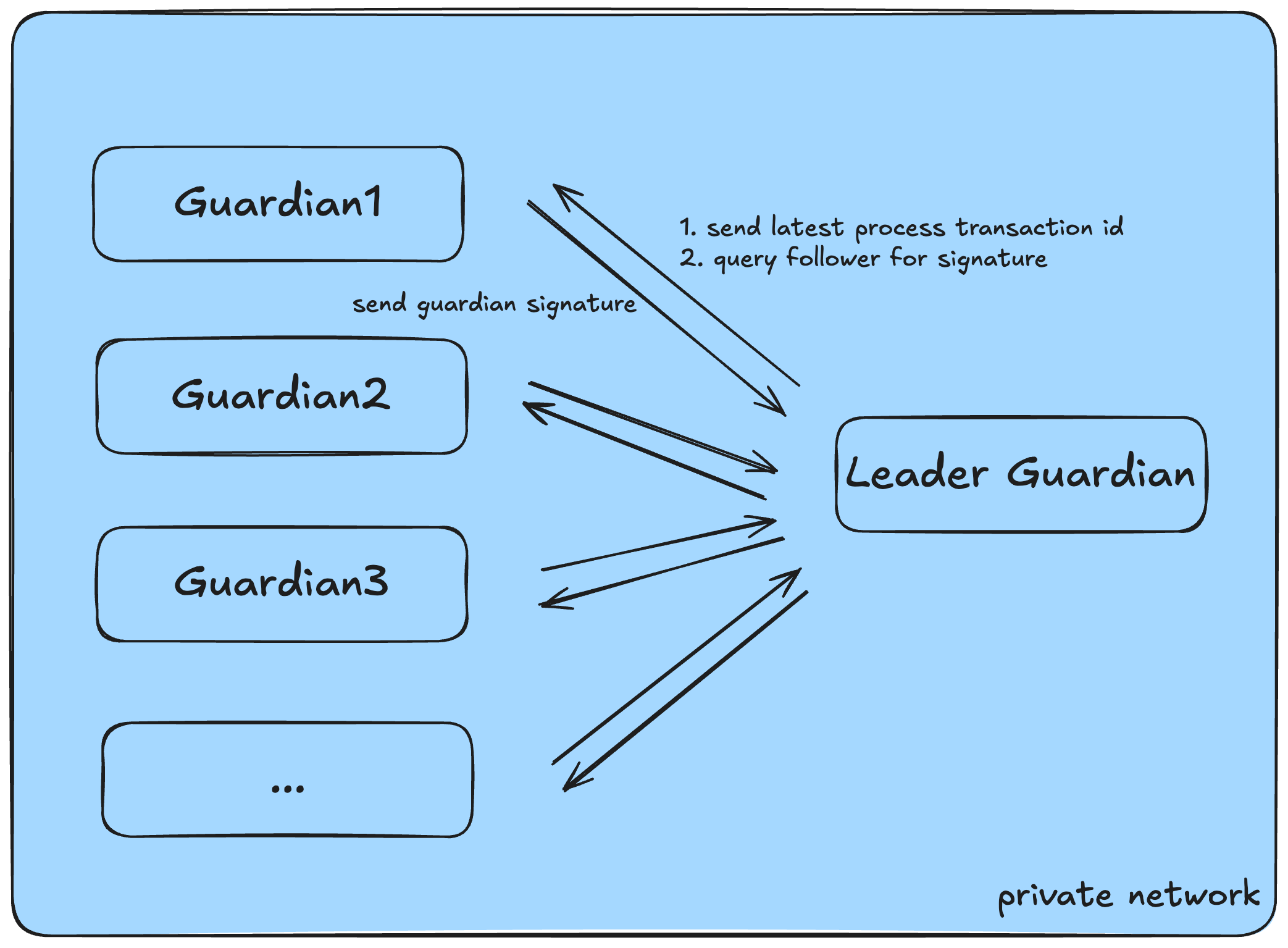
Transaction Subscription
Each guardian operates against a dedicated RPC endpoint and is responsible for continuously polling new transactions of the bridge program on the source chain. For both Solana and Solayer chain, each guardian periodically invokes the getSignaturesForAddress RPC method on the bridge program ID, starting from the most recently processed transaction signature. This position is stored locally in a durable file. Upon retrieval, signatures are fetched in reverse chronological order and then resolved to full transactions using getTransaction. This polling mechanism also works well during guardian crash or new guardian catch up cases as long as the local file is stored properly. To ensure exactly-once semantics, guardians maintain a local de-duplication set in memory and persistently store the highest processed transaction signature. This eliminates reprocessing due to retries, even in cases of partial crashes or concurrent recovery.Multi-Sig Aggregation
After validating a transaction, each guardian generates a deterministic hash over the bridge payload: BridgeAsset: H = hash(sender, recipient, mint, amount, nonce, sourceTxId) CrossChainCall: H = hash(sender, calldata, nonce, sourceTxId) Each guardian signs this hash using a Hardware Security Module (HSM), which ensures the private key never enters system memory. The designated leader guardian is responsible for collecting signatures until the threshold ( t ) out of ( n ) is reached (e.g., t = 5, n = 7). Once quorum is reached, the leader packages the multi-signature data into a canonical payload and submits it to the destination chain. The multi-signature scheme supports both static validator sets and dynamic reconfiguration, with guardian public keys stored on-chain and verified using Solana’sed25519_program.
Failure Recovery
- Failure Retry: Bridge execution failures (e.g., transient networking failures) are handled via a fault-tolerant redrive mechanism. Lead guardian continuously scans the cached transaction sessions and process each session based on it’s current status. Each retry operation verifies that the transaction has not already been executed on-chain by checking the existence of its PDA proof. This ensures at-least-once delivery semantics without compromising determinism or duplicity protection from the off-chain module perspective.
- Guardian Leader Failover: Leader failure (e.g., network partition, crash) is mitigated through a rotating leader election strategy. Guardians periodically exchange heartbeats, and if the current leader becomes unresponsive beyond a timeout window, a new leader is elected deterministically (e.g., round-robin by guardian ID). Any follower should be able to quickly rotate as the new leader as they should have up-to-date fault recovery checkpoint locally stored. During transaction processing, leader leader would broadcast highest processed transaction signature to followers after finishing a batch. Even if the checkpoint transaction is slightly delayed from the actual one, the new leader can still quickly catch up as it would check bridge proof PDA on destination chain for each transaction and quickly identifies already committed ones.